

Case Study: Patient Resistant to Anti-VEGF
A 77-year-old male patient presented to my clinic reporting visual distortion in his right eye. As an artist, the patient found this especially noticeable when reading and creating his artwork. He was diagnosed with a choroidal neovascular membrane complicating central serous chorioretinopathy in his right eye. Treatment with monthly anti-VEGF injections was recommended. Initially the patient responded quite well to this regimen, with complete resolution of his distortion and a visual acuity of 20/25 in his right eye.
After 9 months, however, his response to treatment dwindled: Although the patient was receiving one of the stronger anti-VEGF medications, visual acuity in his right eye gradually decreased to 20/40, distortion significantly worsened, and the choroidal neovascularization (CNV) enlarged despite monthly injections (Figure 1).
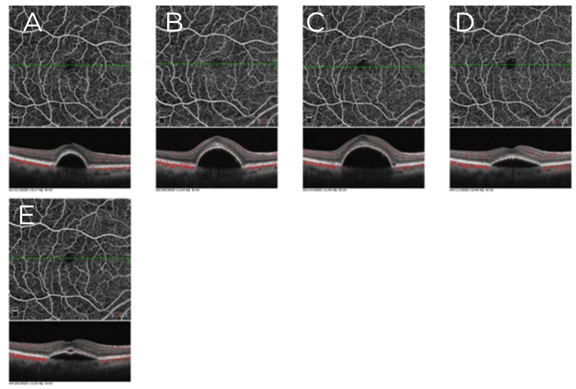
Figure 1 - OCT-A confirmed a CNV complex under the enlarging PED. Images A-C show the patient’s CNV enlarging despite monthly anti-VEGF injections, while images D and E, taken every 2 weeks instead of every 4 weeks, demonstrate improvement with the increased (every 2 weeks) injection frequency.
The patient reported that his vision improved for several weeks after his injections but began to worsen before the 1-month mark. In Figure 1, the first 3 optical coherence tomography angiography (OCT-A) scans, starting at month 9 of treatment and taken monthly, demonstrate serial worsening of the patient’s pigment epithelial detachment (PED) and CNV despite monthly injections. Because of his poor response to the standard treatment, we opted to increase injection frequency to every 2 weeks instead of every 4 weeks. The fourth and fifth scans shown in Figure 1 were both taken at 2 weeks after injection on the new regimen (i.e., taken at 2-week intervals instead of 1-month
intervals) and show significant improvement with the increased injection frequency. Moving to a more frequent injection schedule allowed the patient to regain his visual acuity and resolved his distortion.
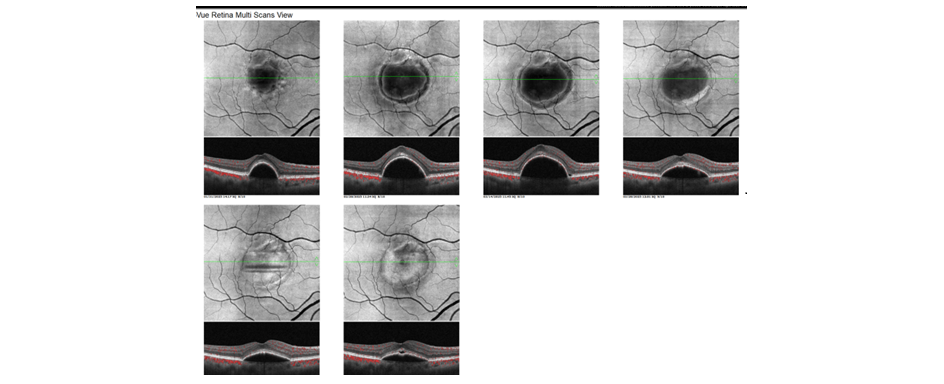
OCT and OCT Angiography (OCT-A) were performed using the Optovue Solix platform (Visionix) to evaluate the patient's structural abnormalities and better characterize the neovascularization. OCT-A confirmed a CNV complex under the enlarging PED (Figure 1). The OCT-A scans in Figure 2 show the CNV within this PED, and Figure 3 shows the en face OCT scans demonstrating worsening and resolution of the CNV and PED. Robust
comparisons permitted up to 8 dates to be shown in one multi-scrollable image and allowed for seamless switching between each view (i.e., en face OCT and OCT-A) on the fly. The OCT-A enabled assessment of the choroidal neovascular membrane, while the en
face tool showed resolution: The darker the image, the denser the fluid. Thus, it was easier to assess and show the patient the ebbs and flows of his disease, and multiple tools facilitated quick decision-making regarding treatment changes—namely, in this patient’s case, increasing treatment frequency.
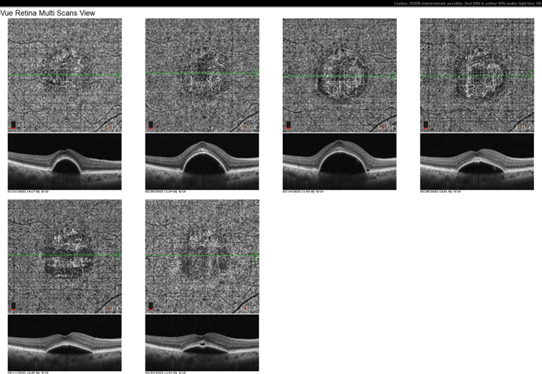
Figure 2 - OCT-A scans show the CNV network within the PED.
In this case, the en face imaging was helpful to assuage the patient’s concerns that his condition would continue to worsen. Once he saw improvement with the increased injection frequency, he felt more comfortable about the treatment, and we continued
the treatment course. He has since benefited from photodynamic therapy, which has allowed us to modify injection frequency to every 3 weeks. His PED continues to improve, and his visual acuity is back to his post-treatment baseline of 20/25.
Choroidal neovascularization, most frequently seen in patients with macular degeneration, is a common disease in the retina clinic. This case was unique in that most patients respond to monthly anti-VEGF injections, and, for many patients, treatment
intervals can be extended even further. This patient was treatment resistant to the standard regimen of monthly anti-VEGF injections. Because the patient noticed that his treatment effect faded more quickly than expected, we used OCT and OCT-A imaging
to evaluate the structural changes associated with his choroidal neovascular membrane and were able to manage his disease and improve his vision with a treatment plan tailored to him.
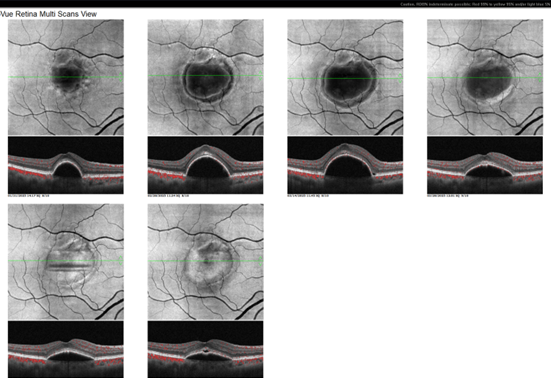 Figure 3 - En face OCT scans demonstrate worsening and resolution of the
patient’s CNV and PED.
OPTOVUE SOLIX BY VISIONIX
- The ONLY OCT with FDA-cleared OCT-A metrics
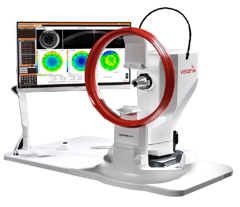 FullRange® Retinal 16x6.25mm scan
- FullRange® Anterior Chamber 18x6.25mm scan
- Ultra-fast 120kHz scan speed
- Higher scan density & precision vs. other OCTs/OCT-As
- Integrated fundus camera
- External color & IR imaging
- New optional Topography Module available!
This article originally appeared in Ophthalmology Management in March 2026.

Dr. Alexander Barash is a vitreoretinal surgeon and retinal specialist with a solo practice in New York City at New York Retina Care. He graduated magna cum laude from Cornell University and earned his MD from Icahn School of Medicine at Mount Sinai. He completed his ophthalmology residency at Stony Brook University Hospital and a vitreoretinal fellowship at NY Eye and Ear Infirmary of Mount Sinai. He also trains ophthalmology residents and retina fellows at NY Eye and Ear and Mount Sinai Hospital and has won
awards for teaching and dedicated service in this
role.
Outside of his clinical practice, Dr. Barash helps conduct ophthalmic surgery missions around the
world. He directed eye clinic services on missions to Uganda and Peru and has been a member of surgical mission trips to Mongolia since 2011. He is an active researcher with numerous publications and presentations, including work supported by a Doris Duke Clinical Research Fellowship.
**The information provided is for general informational purposes only. It is not intended to replace and should not be considered a substitute for professional medical advice, diagnosis, or treatment. The content is not designed to replace the relationship between a patient and their healthcare provider. Any medical decision should be made in consultation with a qualified healthcare professional who can provide information tailored to your individual situation. Medical procedures, case studies, and practices mentioned in this content may vary depending on regional standards, local regulations, and the discretion of the healthcare provider. The views and experiences expressed are those of the individual user. They may involve off-label use of the medical device, which is not endorsed or approved by the manufacturer. What may be considered appropriate and ethical in one country may differ in another. The content may include general references to medical practices, medications, or treatments that are widely accepted in certain regions but may not be universally applicable or approved. It is important to consult a healthcare professional in your jurisdiction to ensure that the information is relevant to your specific situation. The authors, editors, and contributors of this content disclaim any liability for any adverse effects resulting directly or indirectly from the information contained herein. Readers should exercise their own judgment and seek advice from healthcare professionals when necessary. By accessing and using this content, you acknowledge and accept the terms of this disclaimer.