

The Precision Paradox: Why Automated Wavefront Lensmeters "Misread" Digital Lens Prescriptions
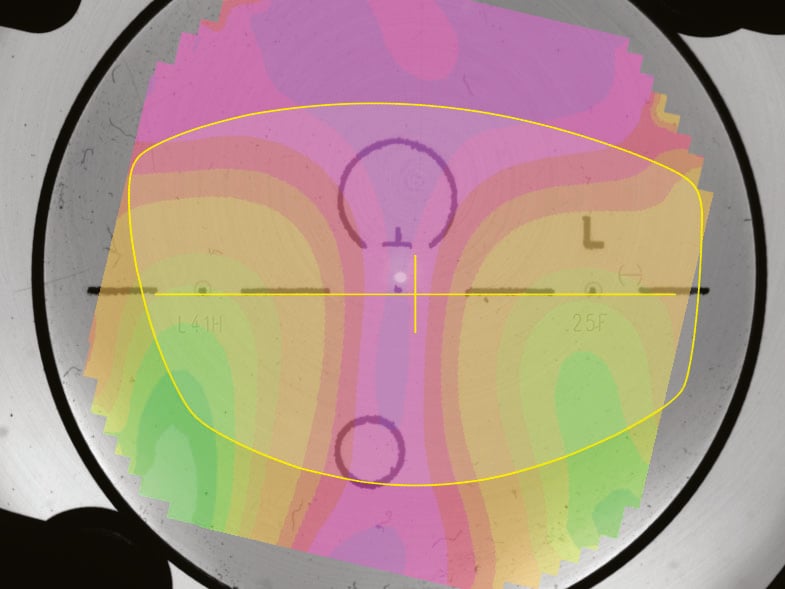
In the modern optical dispensary, automated lensmeters utilizing wavefront technology represent the pinnacle of objective verification. However, eye care professionals frequently encounter a confusing discrepancy: a premium, digitally optimized lens reads differently on an automated lensmeter than the prescription written by the doctor.
When verifying these advanced designs on a wavefront analyzer like the Visionix VX 40, this variance is not a fabrication defect or an equipment malfunction. It is the intentional result of digital lens optimization—a necessary divergence between the Prescribed Rx and the Compensated Rx.
1. The Geometry of the Refraction Room vs. Real Life
The root of the discrepancy lies in the physical environment where a prescription is born. During a standard refraction, the patient sits behind a phoropter. In this clinical setting, the testing lenses are held perfectly vertical, parallel to the patient's face, and at a fixed vertex distance—typically 12 to 14mm.1
However, when a patient selects a real-world frame that idealized geometry disappears. The lenses are subject to three distinct positional variables known as Position of Wear (POW):2
- Vertex Distance: The actual distance from the back surface of the lens to the apex of the cornea.
- Pantoscopic Tilt: The vertical angle of the lens relative to the patient's face (tilting inward toward the cheeks).
- Panoramic Angle (Face Form Wrap): The horizontal curvature of the frame front wrapping around the face.
2. The Optical Consequences of Frame Fit
When a standard spherical or spherocylindrical lens is tilted or wrapped on a patient's face, it alters the effective power of the lens. According to classic optical physics (specifically Martin's Equations), tilting a lens introduces unwanted astigmatism and changes the sphere power.3
For example, a high-minus lens with significant pantoscopic tilt will naturally generate unwanted cylinder power that the doctor never intended. In standard surfacing, the patient simply had to tolerate this peripheral distortion and reduced visual acuity.
3. Digital Freeform and the Compensated Rx
Digital freeform manufacturing eliminates these lens aberrations by calculating the optical errors before the lens is cut.4 The proprietary software calculates how the frame's specific pantoscopic tilt, wrap, and vertex distance will alter the light rays entering the eye.
To cancel out the anticipated distortions, the software intentionally alters the prescription carved into the back surface of the lens. This resulting calculation is the Compensated Rx (or Verification Power).5
If a wrapped frame is calculated to naturally induce +0.25 of unwanted cylinder at the patient's eye, the freeform software will alter the fabrication instructions to grind -0.25 into the lens, perfectly neutralizing the error when worn.
4. The Role of the Visionix VX 40 and Its Reliability Parameters
An automated lensmeter evaluates a lens based on its raw, physical optics outside the context of the human face. The Visionix VX 40 does not read lenses using a traditional single-point light beam. Instead, it relies on automatic alignment and high-resolution Shack-Hartmann wavefront sensor technology.
The VX 40 breaks down a 7mm area of the lens into a matrix of up to 1,350 individual measurement points, reconstructing the optical wavefront in real time. Because the VX 40 measures the lens in a flat, un-tilted orientation, it captures the exact physical properties etched by the lab generator. It reads the Compensated Rx, which frequently differs by an eighth or a quarter of a diopter from the doctor's original orders.
Parameters of Reliability and Data Integrity
To achieve a high degree of precision without manual user bias, the VX 40 utilizes several automated parameters to ensure measurement reliability.
- Operator-Independent Alignment: Traditional lensmeters rely heavily on the optician manually centering the target on a reticle. The VX 40 utilizes automatic lens recognition and centering, eliminating human error in finding the exact optical center.
- Green Light Measurement (540 nm): The system operates near the international standard green reference wavelength. This matches the standard reference wavelength for lens power calibration (e\text{-line or } d\text{-line}), reducing errors stemming from Abbe number variations (chromatic aberration) across different lens materials like polycarbonate or high-index.
- Progressive Map Validation: For progressive addition lenses (PALs), the VX 40 maps the entire corridor automatically. Rather than guessing where the distance or near zones sit, its algorithm analyzes the gradient of the wavefront map to locate the stable zones, ensuring that power readings are taken at the exact intended reference points.
How to Properly Verify Optimized Lenses
Because of this optical paradox, comparing a wavefront lensmeter reading directly to the doctor's written prescription is an inaccurate method of quality control. To ensure standard compliance:
- Retrieve the Lab Metrics: Locate the job packet, invoice, or paper sleeve provided by the optical laboratory.
- Identify the Verification Power: Find the specific matrix labeled "Compensated Rx," "As-Worn Rx," or "Verification Power."
- Apply ANSI Tolerances: Verify the VX 40 readings against these compensated values using standard ANSI Z80.1 guidelines.8 If the readings match the lab's compensated matrix, the lens will perform exactly as the doctor intended when placed on the patient's face.
References
- Brooks, C. W., & Borish, I. M. (2007). System for Ophthalmic Dispensing. Butterworth-Heinemann.
- Meister, D. J., & Fisher, S. W. (2008). Progress in the spectacle lens design and manufacture. Optometry and Vision Science, 85(10), 902-911.
- Jalie, M. (2008). The Principles of Ophthalmic Lenses. The Association of British Dispensing Opticians.
- Brunton, J. (2014). Freeform technology: What does it mean for the independent practice? Optometry in Practice, 15(4), 143-152.
- Fowler, C., & Petre, K. L. (2001). Spectacle Lenses: Theory and Practice. Butterworth-Heinemann.
- Liang, J., Grimm, B., Goelz, S., & Bille, J. F. (1994). Objective measurement of wave aberrations of the human eye with the use of a Shack–Hartmann wave-front sensor. Journal of the Optical Society of America A, 11(7), 1949-1957.
- Visionix. (2021). VX 40 Wavefront Automatic Lensmeter Technical Specifications & User Manual. Visionix Luneau Technology.
- American National Standards Institute. (2020). ANSI Z80.1-2020: Ophthalmics - Prescription Spectacle Lenses.
Standout Features of the VX 40 Wavefront Analyzer
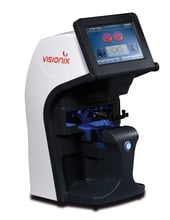
- Fully automated one-touch lens analysis
- Wavefront lens analysis
- Side-by-side comparative lens analysis
- Complete prescription analysis in 30 seconds or less
- Can detect and analyze bifocals, progressive, and single vision lenses
**The views and experiences expressed are those of the individual user. They may involve off-label use of the medical device, which is not endorsed or approved by the manufacturer. Medical procedures, case studies, and practices mentioned in this content may vary depending on regional standards, local regulations, and the discretion of the healthcare provider. Not all products, accessories, services, or offers are approved in every market.
About the Author

Edward Jiongco, ABOC, NCLEC, LDO (NV)
Edward Jiongco, ABOC, NCLEC, LDO (NV) is a Nevada-licensed optician certified by the American Board of Opticianry and the National Contact Lens Examiners. He currently serves as Account Manager and Finishing Specialist for Visionix | iCarev, where he supports optical practices in improving profitability, workflow efficiency, and in-house lens finishing processes. Edward is also a Board Member for the College of Southern Nevada’s Ophthalmic Dispensing program, helping provide vision care to underserved communities and mentor opticians.