
OCT-A Technology Fuels Patient Education, Wellness
After years of fitting specialty contact lenses for patients with complex corneal conditions, Ariel Cerenzie, OD, FAAO, FSLS, knows what works in the exam lane—and what doesn't. Her practice focuses on scleral lenses, keratoconus, and other hard-to-fit cases, which means every clinical decision must be precise and efficient. That experience has shaped how she evaluates new technology; she prioritizes tools that support both patient outcomes and workflow, as well as patient understanding.
Dr. Cerenzie says that innovation in eye care not only improves diagnostics and efficiency but also fuels education, helping patients better understand their condition and engage in their care. When she opened Charlotte Contact Lens Institute in Charlotte, North Carolina, she wanted imaging equipment that could support the level of care she wanted to provide. She had worked with OCT systems earlier. However, she found that many options were not intuitive or efficient enough for the workflow she envisioned. She required a system that could capture broad, detailed images in a single scan, without the need to stitch together multiple images.
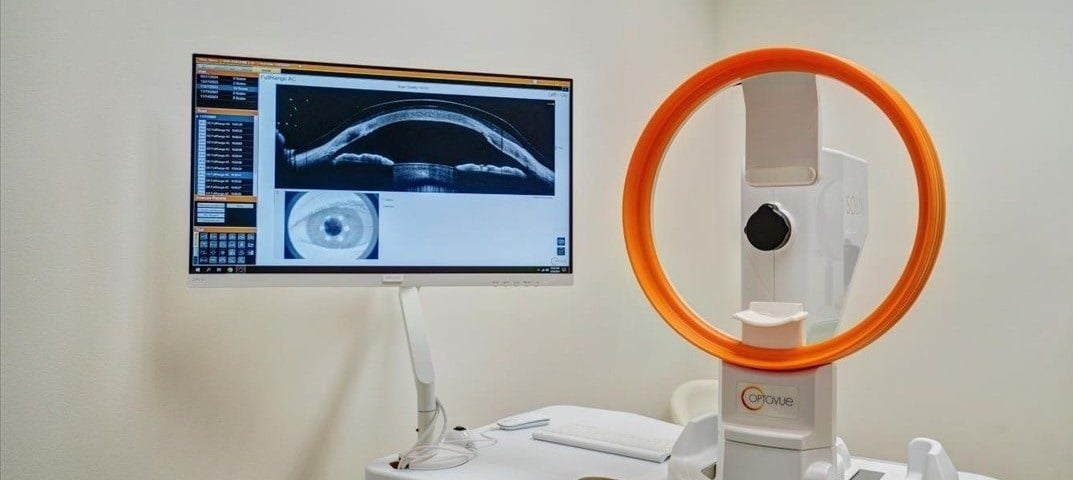
About 10 months after opening her Charlotte location in 2024, she integrated the Optovue Solix OCT/OCT-A by Visionix into her workflow. It immediately supported her approach to specialty care. When she opened her second location in 2025, she made sure to incorporate it on day one.
Precision in Scleral Lens Care
Dr. Cerenzie says the advanced imaging has helped refine her scleral lens fitting process by providing objective, reproducible data. Instead of relying primarily on slit lamp evaluation, she can assess clearance, alignment, and limbal health with greater precision.
“The Optovue Solix OCT/OCT-A has become an integral part of my daily clinical workflow, particularly for complex scleral lens fittings,” she says. “I routinely use the anterior segment OCT radial scans with the 18 mm cross-section to assess scleral clearance over irregular corneas.” In keratoconus cases, clearance can vary dramatically, from minimal clearance at the apex to excessive clearance in the mid-periphery. It is also impactful for patients with tilted corneal grafts, where clearance can change across every semi-meridian.
“I also frequently rely on the corneal line scan to evaluate edge angle and scleral alignment, as well as limbal clearance, which allows for more precise, data-driven lens adjustments and ultimately improves fitting efficiency and patient outcomes. Having the ability to perform posterior segment and wellness scans quickly has been incredibly helpful in confirming that reduced vision is related to anterior segment pathology rather than posterior segment disease.”
Improving Efficiency and Workflow
Efficiency became even more important as Dr. Cerenzie expanded to a second location. She wanted technology that could streamline care without adding complexity or slowing down her team.
She says the system was straightforward to learn and easy for staff to incorporate into the workup process. Imaging is now routinely captured for many specialty contact lens patients, allowing her to enter the exam with objective data already available. This helps guide decision-making, reduces chair time, and minimizes the need for repeated adjustments.
The ability to consolidate anterior and posterior imaging also supports smoother patient flow. Instead of moving patients between multiple devices, the team can gather comprehensive diagnostic information at one device. The imaging integrates into the patient record, improving documentation and continuity of care across both locations.
Plus, the comprehensive imaging has broadened the diagnostic capabilities of her practice. Posterior segment and wellness scans allow her to quickly evaluate retinal and optic nerve health, particularly for new patients. This additional data helps confirm whether reduced vision is related to corneal or retinal disease and supports earlier detection of conditions and potentially earlier intervention.
Enhancing Patient Understanding and Compliance
The efficiencies she has gained allow her more time to explain findings and help patients understand their eye health. The innovation in imaging technology has transformed how she communicates with patients and how they engage in their care.
Showing cross-sectional images of the eye and scleral lens helps patients visualize issues such as lens touch or inadequate clearance. They better understand why adjustments or replacements are necessary. This visual approach strengthens trust and improves compliance, especially for patients managing progressive or chronic conditions such as keratoconus.
As diagnostic tools continue to evolve, she says eye care providers have an opportunity not only to improve precision and efficiency but also to elevate how they educate patients. She encourages colleagues to remain curious and invest in continuing education, emphasizing that innovation is most impactful when it helps patients better understand their eye health and take an active role in their care.
As specialty contact lens care continues to evolve, she believes that combining advanced imaging, ongoing education, and strong communication will help the profession move forward—supporting earlier diagnosis, more personalized treatment, and stronger patient relationships.
OPTOVUE SOLIX OCT/OCT-A BY VISIONIX
- The ONLY OCT with FDA-cleared OCT-A metrics
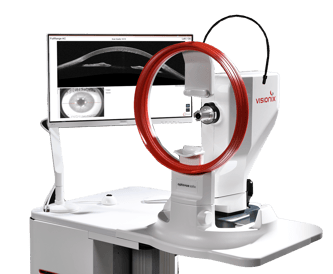
- FullRange® Retinal 16x6.25mm scan
- FullRange® Anterior Chamber 18x6.25mm scan
- Ultra-fast 120kHz scan speed
- Higher scan density & precision vs. other OCTs/OCT-As
- Integrated fundus camera
- External color & IR imaging
- New optional Topography Module available!

ARIEL CERENZIE, OD, FAAO, FSLS
Dr. Ariel Cerenzie is a West Texas native who now calls North Carolina home. She earned her Bachelor of Science degree from Texas A&M University and her Doctor of Optometry degree from the University of Houston College of Optometry, graduating magna cum laude. After being diagnosed with keratoconus and experiencing years as a “hard-to-fit” patient, she developed a passion for specialty contact lenses and complex eye care.
Dr. Cerenzie completed a cornea and contact lens residency at University of Missouri–St. Louis, where she advanced her expertise in specialty lenses, corneal disease, post-surgical care, and myopia management. She is a Fellow of the American Academy of Optometry (FAAO) and the Scleral Lens Education Society (FSLS)—a distinction held by fewer than 300 practitioners worldwide—and is a nationally recognized speaker on myopia management and specialty contact lenses. She currently practices at Charlotte Contact Lens Institute in Charlotte, NC.
This article originally appeared in Women in Optometry in April 2026: https://www.womeninoptometry.com/visionix/article/oct-a-technology-fuels-patient-education-wellness/
Disclaimer: The views and experiences expressed are those of the individual user. They may involve off-label use of the medical device, which is not endorsed or approved by the manufacturer.