

Case Study: When the Answer Isn’t Clear: The Power of Comprehensive Data in Clinical Decision-Making
-2.png?width=1250&name=Article%20Figure2_UPDATED%20(1)-2.png)
Every practicing clinician has experienced cases where it seems no correct answer exists. It’s the grey area of medicine – the place most cases lie. In these cases, it is vital that the clinician gathers as much data as possible to have comprehensive conversations with the patient as they decide the best future management. This case report will discuss a 15-year-old male who presented on referral for progressive keratoconus worse in the right eye than the left. Due to the condition of his right cornea, it was vital that the risks and benefits of epithelium-off corneal crosslinking were considered.
Case Report
A 15-year-old male patient was referred for a corneal crosslinking evaluation to treat his bilateral progressive keratoconus, worse in the right eye than the left. The patient’s spectacle corrected visual acuity was 20/200 and 20/20 in the right and left eye respectively, and 20/20 with both eyes together. Extraocular motility, confrontation fields, and pupil testing were all unremarkable. Anterior segment examination revealed unstable keratoconus in both eyes. The right eye showed significant inferior corneal thinning and steepening, Vogt’s striae, non-central corneal scarring, and a Fleischer’s ring as seen in Figure 1. No visible signs of keratoconus were present on anterior segment examination in the left eye.
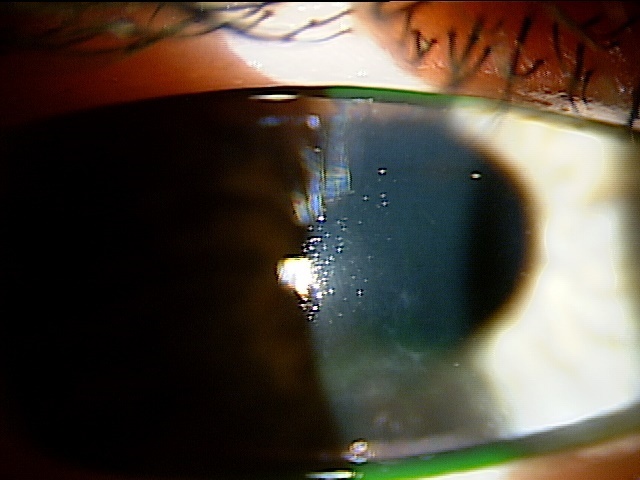 Figure 1. Slit lamp photography showing visible signs of keratoconus OD.
Corneal tomography scans were performed in both eyes. Tomography scans of the right eye revealed significant inferior corneal thinning with adjacent steepening. Inferior elevation of the posterior and anterior corneal surfaces was obvious, and a maximum keratometry value of 83 diopters confirmed his severe keratoconus (Figure 2). The left eye’s tomography showed early signs of keratoconus including inferiorly displaced corneal thinning, asymmetric corneal astigmatism, and moderate posterior surface elevation overlying the thinnest corneal point (Figure 3). The scans also depicted progression of both corneas from the prior corneal tomography scans with corneal thinning of ~10% OS and 1 diopter of corneal steepening OD within one month’s time, thus meeting the progression qualifications for epithelial-off corneal crosslinking in both eyes.
.png?width=729&height=441&name=Article%20Figure2_UPDATED%20(1).png)
Figure 2. Tomography of the right eye reveals inferior corneal thinning and steepening with significant increase in elevation on both the posterior and anterior corneal surfaces.
.png?width=729&height=441&name=Article%20Figure3_UPDATED%20(1).png) Figure 3. Tomography of the left eye revealing inferiorly displaced corneal thinning, asymmetric corneal astigmatism, and moderate posterior surface elevation overlying the thinnest corneal point.
Figure 3. Tomography of the left eye revealing inferiorly displaced corneal thinning, asymmetric corneal astigmatism, and moderate posterior surface elevation overlying the thinnest corneal point.
Traditional tomography devices do not allow for the mapping of the corneal epithelium and provide only a total pachymetric value. Due to the extreme thinning in the patient’s right eye, it was vital that the clinician assess the true stromal thickness on a device capable of epithelial mapping value prior to qualifying the eye for epithelial-off corneal crosslinking. This was done utilizing the Optovue Solix OCT/OCT-A by Visionix (Figures 4 and 5).
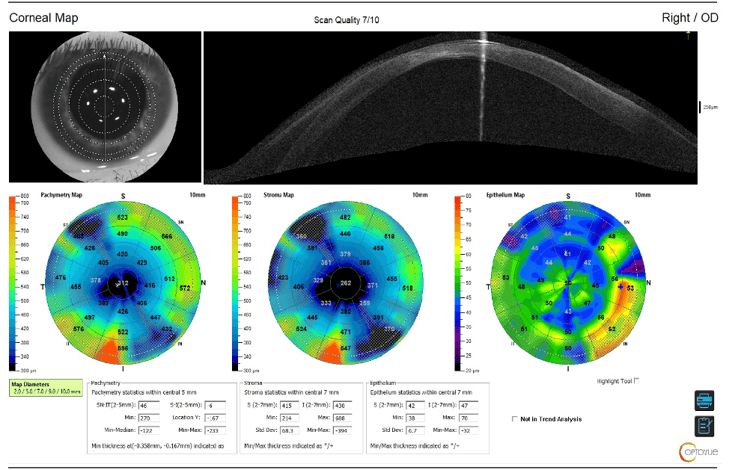 Figure 4. Corneal mapping of the right eye shows total pachymetry, stromal bed thickness, and epithelial thickness.
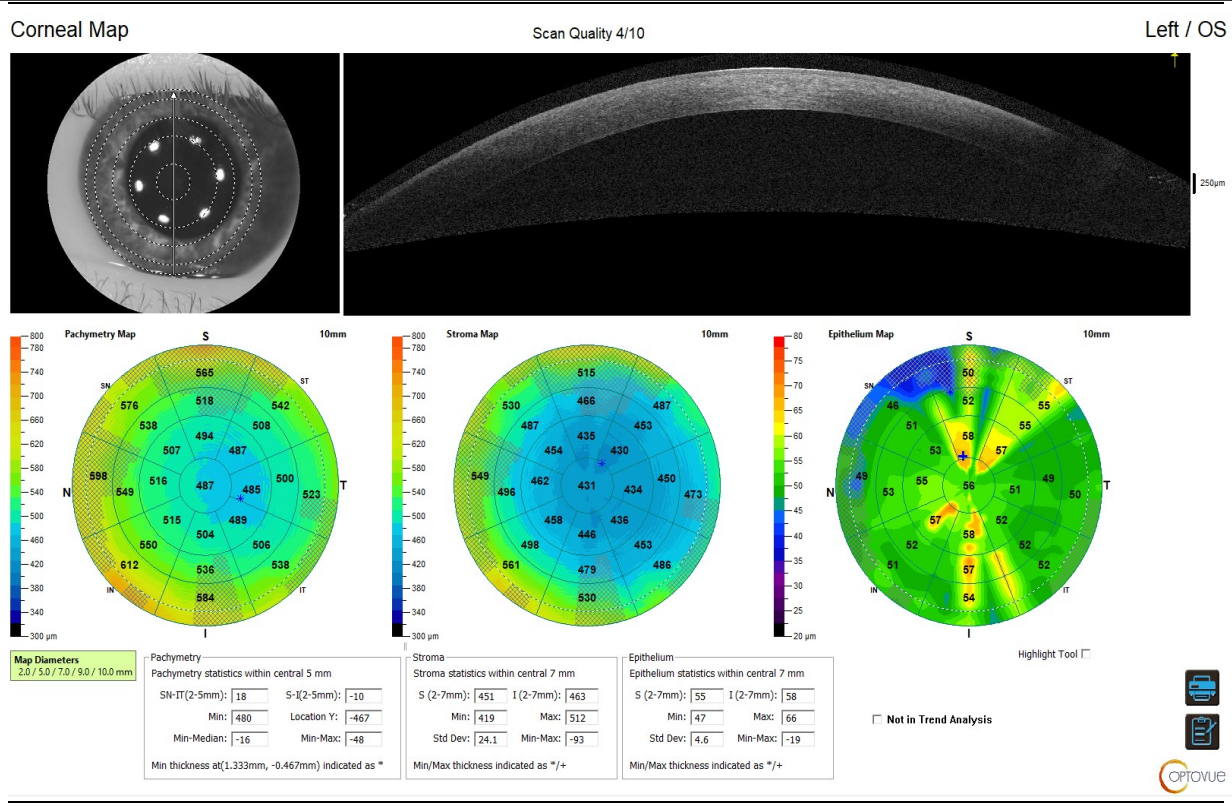
Figure 5. Corneal mapping of the left eye showing total pachymetry, stromal bed thickness, and epithelial thickness.
Discussion
The advent of corneal crosslinking as a tool in our keratoconus toolbox is one that has changed the prognosis of the condition completely. A condition that once was known for a near definite fate of corneal transplantation, is now one that can be managed and slowed to preserve vision.1 As such, it is critical that practitioners are screening for and diagnosing keratoconus early in the disease state and monitoring for progression routinely to prevent sight loss in their patients. Corneal crosslinking is indicated in cases of progressive ectasia. Progression is defined differently by different entities; however, the most widely accepted criteria include steepening of one diopter of any keratometry value, thinning of the thinnest point by 2-5%, refractive shift of -0.50D spherical equivalent, or a reduction in BCVA of 1 line or more.2 These criteria are often time bound within one year. The patient discussed in this case report definitively meets the progression criteria in both eyes even within one month’s time; however, more aspects of the case, such as corneal thickness, must be considered prior to qualifying the patient for surgery.
Intraoperatively, the surgeon must achieve a post debridement thickness of 400 micrometers or greater. This thickness must be confirmed prior to the initiation of UV irradiation to prevent iatrogenic damage to the endothelium. In cases where the post debridement thickness is less than 400 micrometers, hypotonic riboflavin formulations can be used to induce stromal swelling for protection of the corneal endothelium. One aggregate study found that the average achievable rate of corneal swelling is approximately 10 micrometers per 30 seconds with the steepness of the cornea being the largest factor to modulate that rate.3 Steeper corneas are known to swell faster than flatter corneas. Very little data exists on corneas with thicknesses below 300 micrometers, thus the ability to understand the corneal dynamics and potential risks associated with significant amounts of intraoperative corneal swelling is limited.4 For this reason, it is crucial that surgeons managing patients with extreme corneal thinning have an understanding of the epithelial thickness prior to entering the operating room. Because imaging techniques have improved, it is now understood that one of the early signs of keratoconus includes epithelial remodeling. As the stroma begins to protrude forward, the epithelium will thin over the corneal apex and thicken in a circumferential pattern to maintain the anterior corneal curvature.5 Based on this understanding, we cannot assume that a keratoconic eye has the standard 50 micrometer epithelium prior to performing an epithelial debridement. In this patient case, the epithelium has remodeled, and the residual stromal bed thickness is a mere 262 micrometers – significantly less than the minimum required 400 micrometers prior to irradiation. The significant epithelial remodeling can be visualized in the OCT image seen in Figure 6.
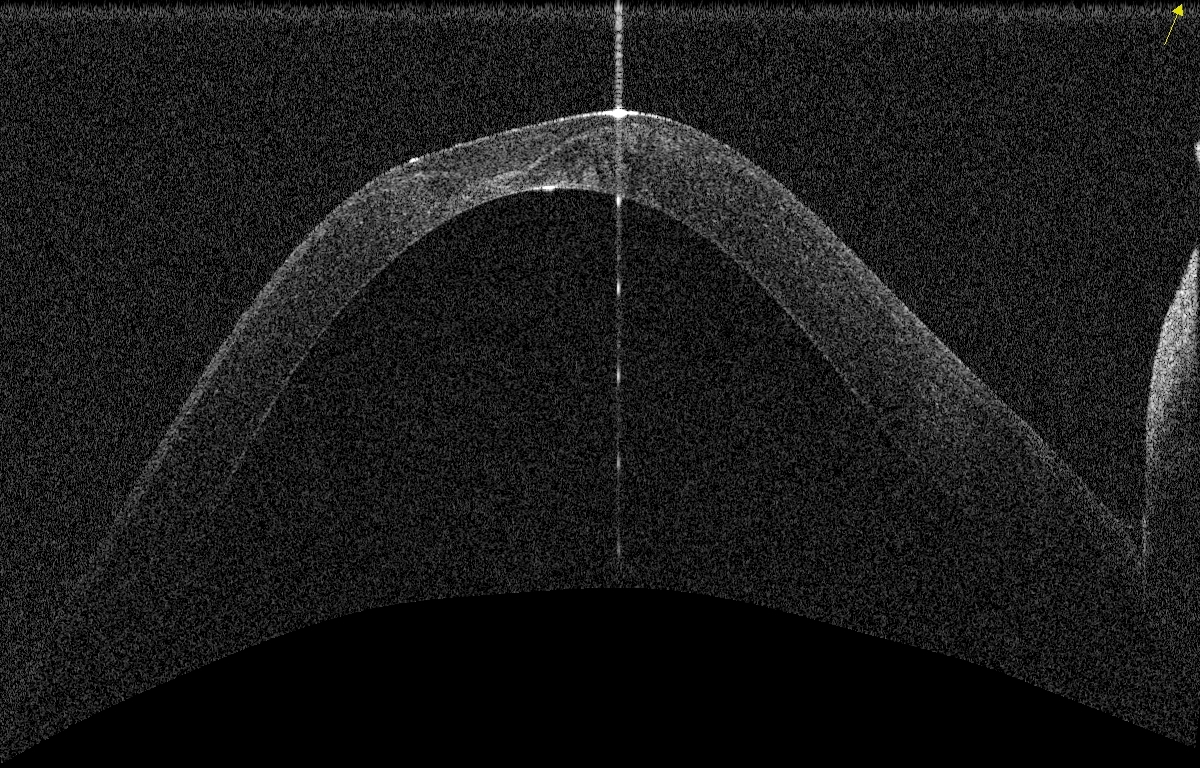 Figure 6. OCT scan image of the right cornea showing significant epithelial remodeling near the corneal apex with a very thin residual stromal bed in the area, and stromal haze below the line of sight.
OCT imaging in conjunction with slit lamp examination of the patient also reveals a lack of corneal clarity with the inferior scarring on the right cornea. One of the known complications following corneal crosslinking is corneal haze. This haze is rarely visually significant,; however, it is one of the most common causes of reduced BCVA following corneal crosslinking.6 It has been found that the best predictor for visually significant corneal haze and scarring following a corneal crosslinking procedure is preoperative densitometry. A clearer preoperative cornea is less likely to develop visually significant haze and scarring than a cornea that is less clear prior to the procedure.7
The value of the ability to image the remodeled corneal epithelium and understand the residual stromal bed thickness prior to operating cannot be understated in this case. Without that information, an informed decision could not be made as confidently. Due to the extremely low corneal stroma thickness, along with significant baseline corneal haze and scarring, it was decided after conversation with the patient and his caregivers that performing a crosslinking procedure with epithelial debridement on the right eye was not the best option at this time. The patient and parents were informed of the newly FDA-approved epithelium-on procedure that may give more flexibility for thinner corneas as the epithelium will not be completely removed. It was decided that the patient would proceed with corneal crosslinking on the left eye only which was completed without complication maintaining the patient’s 20/20 uncorrected VA. A scleral lens fitting is being initiated in the right eye with a scleral lens corrected VA of 20/80. After consultation with a corneal specialist, due to the patient’s age, a corneal transplant is not being pursued at this time.
Conclusion
Although the perfect answer for the management of this case is not clear, more knowledge of the corneal condition and more data regarding the epithelial thickness gives the provider and family power to make an informed decision. Postponing corneal crosslinking on an already severe eye is certainly not ideal; however, a risk-benefit analysis leans toward waiting for a better alternative and managing vision in the intermediate time. When the clinical picture does not yield a perfect outcome, increase your testing and data to assist you in your clinical decision making.
References
- Tian C, Peng X, Fan Z, et al. Corneal collagen cross-linking in keratoconus: A systematic review and meta-analysis. Sci Rep 2014;4:5652.
- Galvis V, Tello A, Ortiz AI, Escaf LC. Patient selection for corneal collagen cross-linking: an updated review. Clin Ophthalmol. 2017 Apr 7;11:657-68.
- Syed Z, Yu J, Crespo M, et al. Dynamics of Corneal Swelling With Hypoosmolar Riboflavin After Induction During Corneal Collagen Crosslinking in Patients With Progressive Keratoconus. Cornea 44(5): p 567-74, May 2025.
- Mohammadi F, McGuinness MB, Mustafa MZ, et al. Effectiveness and Safety of Cross-Linking in Keratoconus Patients With Corneal Thickness <400 µm: A Systematic Review and Meta-Analysis. Am. J. Ophthalmol. 2026;281:363–83.
- Silverman RH, Urs R, Roychoudhury A, Archer TJ, Gobbe M, Reinstein DZ. Epithelial remodeling as basis for machine-based identification of keratoconus. Invest Ophthalmol Vis Sci. 2014 Mar 13;55(3):1580-7.
- Dhawan S, Rao K, Natrajan S. Complications of corneal collagen cross-linking. J Ophthalmol. 2011;2011:869015.
- Koc M, Uzel MM, Tekin K, et al. Effect of preoperative factors on visual acuity, corneal flattening, and corneal haze after accelerated corneal crosslinking. J Cataract Refract Surg. 2016 Oct;42(10):1483-9.
OPTOVUE SOLIX BY VISIONIX
- The ONLY OCT with FDA-cleared OCT-A metrics
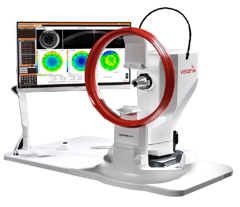 FullRange® Retinal 16x6.25mm scan
- FullRange® Anterior Chamber 18x6.25mm scan
- Ultra-fast 120kHz scan speed
- Higher scan density & precision vs. other OCTs/OCT-As
- Integrated fundus camera
- External color & IR imaging
- New optional Topography Module available!
This article originally appeared in Optometric Management's OCT Insights in May 2026: https://www.optometricmanagement.com/issues/2026/may-june/when-the-answer-isn-t-clear-the-power-of-comprehensive-data-in-clinical-decision-making/
 Aubry Tackett, OD, FAAOMS, is based in Tahlequah, Oklahoma. She earned her Doctor of Optometry (OD) degree from Northeastern State University College of Optometry in 2023. Dr. Tackett was honored with the Dr. Frank D. Fontana Memorial Scholarship that year, recognizing her contributions to the field while still a student. Her primary role involves diagnosing and treating a variety of eye conditions and vision disorders. Dr. Tackett is affiliated with the Cherokee Nation W.W. Hastings Indian Hospital and is an assistant professor at Northeastern State University College of Optometry.
**The information provided is for general informational purposes only. It is not intended to replace and should not be considered a substitute for professional medical advice, diagnosis, or treatment. The content is not designed to replace the relationship between a patient and their healthcare provider. Any medical decision should be made in consultation with a qualified healthcare professional who can provide information tailored to your individual situation. Medical procedures, case studies, and practices mentioned in this content may vary depending on regional standards, local regulations, and the discretion of the healthcare provider. The views and experiences expressed are those of the individual user. They may involve off-label use of the medical device, which is not endorsed or approved by the manufacturer. What may be considered appropriate and ethical in one country may differ in another. The content may include general references to medical practices, medications, or treatments that are widely accepted in certain regions but may not be universally applicable or approved. It is important to consult a healthcare professional in your jurisdiction to ensure that the information is relevant to your specific situation. The authors, editors, and contributors of this content disclaim any liability for any adverse effects resulting directly or indirectly from the information contained herein. Readers should exercise their own judgment and seek advice from healthcare professionals when necessary. By accessing and using this content, you acknowledge and accept the terms of this disclaimer.