

Case Study: Using OCT-A to Rule Out CNV with Confidence
A 92-year-old male presented to the clinic with a complaint of worsening vision in his left eye. The patient had a longstanding history of intermediate AMD (iAMD) OU with prominent subfoveal retinal pigmented epithelial detachment (PED) OU. He typically was seen every four months in the clinic for a dilated exam and OCT/OCT-A. Ocular history was remarkable for cataract surgery approximately five years prior. Medical history was non-contributory.
Visual acuity was 20/40 OD and 20/70 OS. His acuity had decreased from 20/40 OS at his visit two months prior. Intraocular pressure was 13 mmHg OD and 12 mmHg OS via Goldmann applanation tonometry. Anterior segment revealed well-positioned posterior chamber IOLs with mild posterior capsule opacification OU. Posterior segment examination showed large but stable appearing PEDs OU with no evidence of subretinal fluid or hemorrhage.
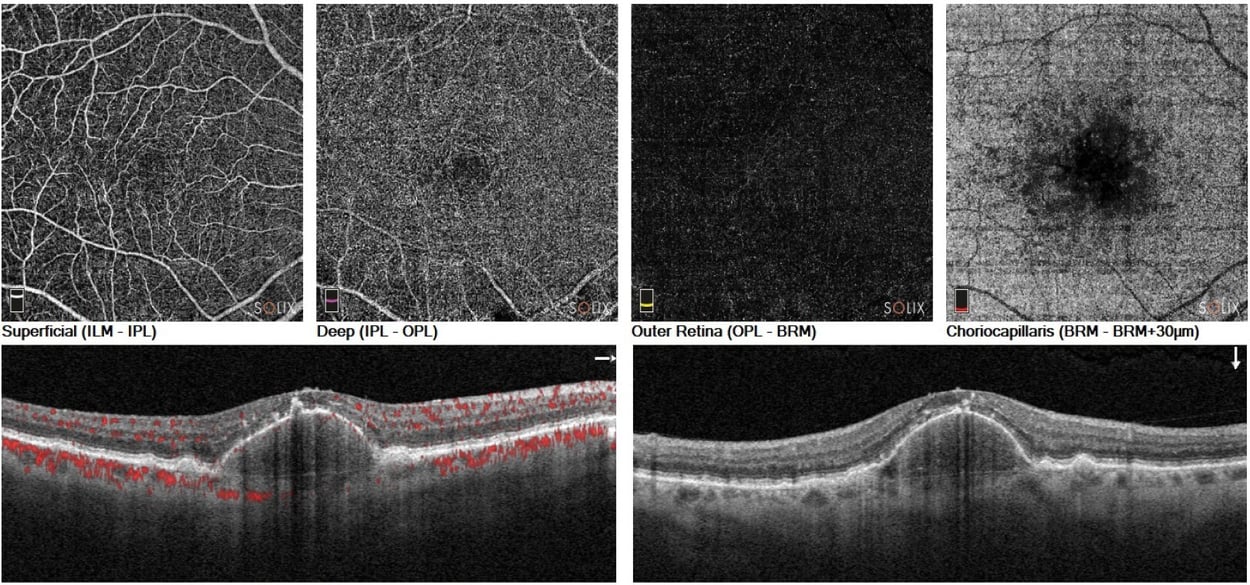
OCT and OCT-A with the Optovue Solix were performed to rule out progression to exudative AMD. In both eyes, large drusenoid PEDs with overlying focal hyper-reflective lesions, consistent with pigment migration, were noted. Careful analysis of the outer retina and choriocapillaris OCT-A slabs showed no evidence of increased flow indicative of macular neovascularization (MNV). Attenuation of the subfoveal ellipsoid zone was noted OU. Progressive disruption to his outer retina has led to progressive vision loss in the absence of MNV or geographic atrophy (GA) (see Figures 1 & 2).
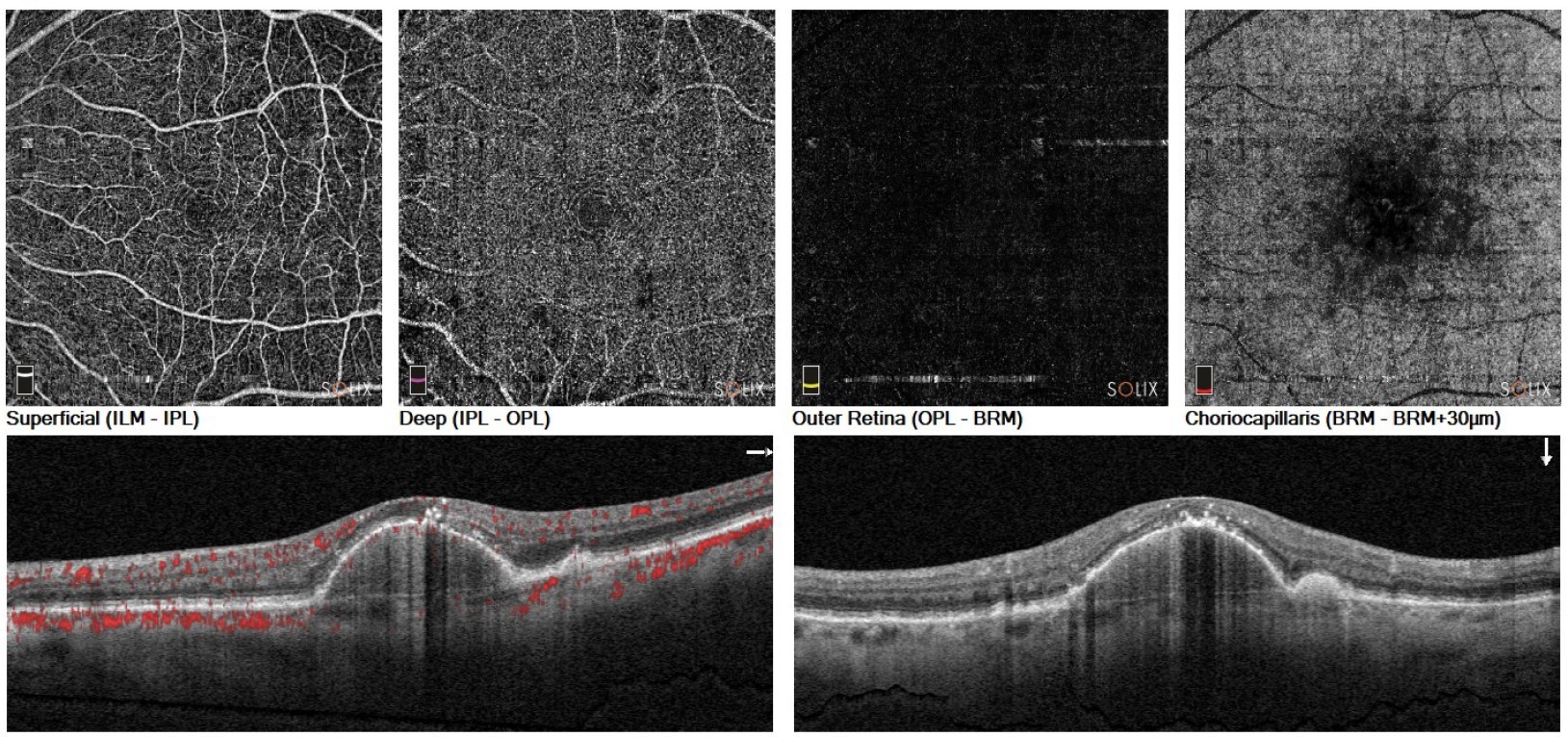
Figure 1. OCT and OCT-A with the Optovue Solix was performed for both the right and left eyes to rule out progression to exudative AMD. In both eyes, large drusenoid PEDs with overlying focal hyper-reflective lesions, consistent with pigment migration, were noted. Careful analysis of the outer retina and choriocapillaris OCT-A slabs showed no evidence of increased flow indicative of macular neovascularization (MNV).
PEDs are characterized by separation between the retinal pigment epithelium (RPE) and Bruch’s membrane. In AMD, PEDs may be classified as drusenoid, serous, fibrovascular, or mixed. Large drusenoid PEDs should be evaluated with OCT-A to rule out macular neovascularization (MNV)i.
In this case, the patient’s symptoms were concerning for progression to advanced AMD. OCT and OCT-A confirmed the absence of MNV without the need for more invasive testing. Consequently, it was determined that treatment was not indicated and referral to a retina specialist was not warranted. The patient was educated about his disease progression and counseled to continue follow-ups in the clinic every four months. Additionally, he was asked to continue his AREDS2-based supplements and promptly report any changes in vision.
OCT-A is an essential, non-invasive tool that helps clinicians distinguish neovascular from non-neovascular PEDs. Confident treatment recommendations can be made without the need for a referral or more invasive testing.
OPTOVUE SOLIX BY VISIONIX
- The ONLY OCT with FDA-cleared OCT-A metrics
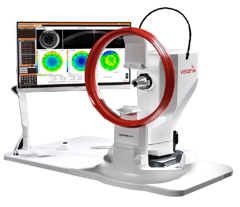 FullRange® Retinal 16x6.25mm scan
- FullRange® Anterior Chamber 18x6.25mm scan
- Ultra-fast 120kHz scan speed
- Higher scan density & precision vs. other OCTs/OCT-As
- Integrated fundus camera
- External color & IR imaging
- New optional Topography Module available!
 Dr. Dierker is the Director of Optometric Services at Eye Surgeons of Indiana. He is a graduate of the Indiana University School of Optometry and has completed fellowship training in consultative optometry. He specializes in the diagnosis and management of eye diseases.
In 2007, Dr. Dierker was awarded Fellowship in the American Academy of Optometry. This prestigious honor is given to only a small number of optometrists throughout the country. As an adjunct faculty member at the Indiana University School of Optometry, he directs the clinical externship program at Eye Surgeons of Indiana. Recently, he has served his profession as President of the Indiana Optometric Association. Additionally, he frequently presents continuing education lectures to other doctors throughout the country and works closely with leaders in industry on various endeavors that are focused on improving patient care. He is the founder of Dry Eye Boot Camp and co-founder of Eyes on Dry Eye, both of which are educational programs for eye care professionals.
**The information provided is for general informational purposes only. It is not intended to replace and should not be considered a substitute for professional medical advice, diagnosis, or treatment. The content is not designed to replace the relationship between a patient and their healthcare provider. Any medical decision should be made in consultation with a qualified healthcare professional who can provide information tailored to your individual situation. Medical procedures, case studies, and practices mentioned in this content may vary depending on regional standards, local regulations, and the discretion of the healthcare provider. The views and experiences expressed are those of the individual user. They may involve off-label use of the medical device, which is not endorsed or approved by the manufacturer. What may be considered appropriate and ethical in one country may differ in another. The content may include general references to medical practices, medications, or treatments that are widely accepted in certain regions but may not be universally applicable or approved. It is important to consult a healthcare professional in your jurisdiction to ensure that the information is relevant to your specific situation. The authors, editors, and contributors of this content disclaim any liability for any adverse effects resulting directly or indirectly from the information contained herein. Readers should exercise their own judgment and seek advice from healthcare professionals when necessary. By accessing and using this content, you acknowledge and accept the terms of this disclaimer.